The Old World’s hardest pivot in a generation
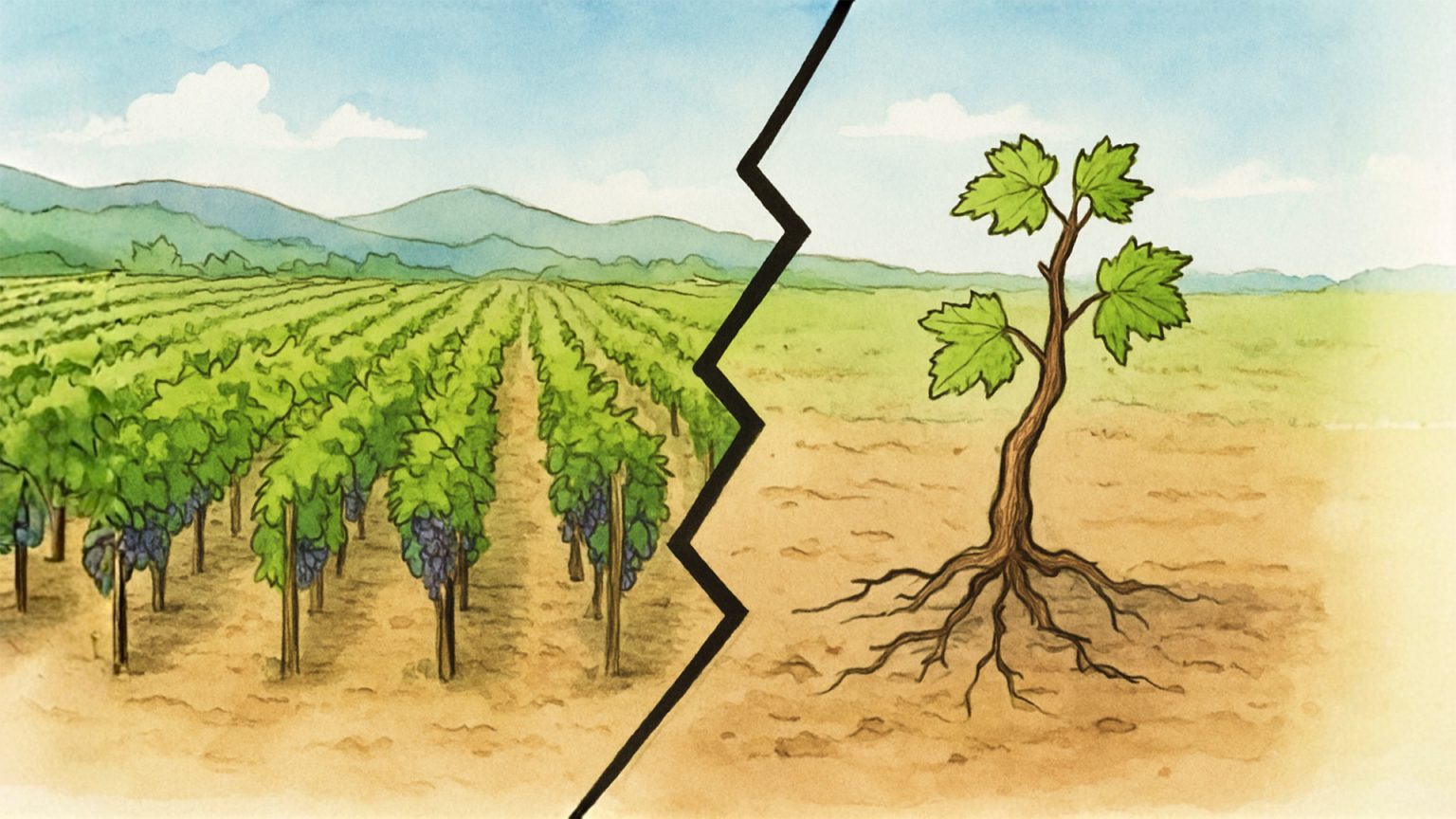
On 24 November 2025 at the SITEVI fair in Montpellier, France unveiled a structural pivot for its wine industry: a €130 million permanent vine-uprooting scheme targeting 32,500 hectares. This marks a policy shift from episodic bailouts to deliberate, long-term downsizing – a response to four consecutive years of climate shocks, sliding domestic demand and trade frictions that together have hollowed out margins across low-cost French wine regions. The package, paired with a request to the EU for distillation funds, signals that France is betting on contraction to stabilise prices and preserve viable estates.
The Plan in Numbers
| Measure | Amount / Scope | Timing / Notes |
|---|---|---|
| Permanent vine uprooting | €130 million (€70m in 2026) | 32,500 ha eligible; ~€4,000/ha grant |
| Structural loans | 70% state guarantee, extended to end-2026 | Criteria revised, now open to cooperatives |
| Social charge relief (MSA) | €15 million total | €5m already disbursed, €10m in 2026 |
| EU crisis reserve request | Distillation of non-marketable surplus | Priority to cooperative cellars |
This is the third consecutive year of major grubbing-up aid: €160m (2023), €230m (2024), now €130m (2025) – more than €520 million in total.
Triple Threat: Climate | Demand | Trade
Climate
Four punishing seasons in a row: frost and drought in 2022, mildew in 2023, rain-induced rot in 2024, and a scorching August heatwave plus wildfires in 2025. France’s 2025 harvest is estimated at 36 million hectolitres – 16% below the five-year average (Agreste, October 2025). In Aude alone, wildfires burned 160 km² this summer.
Demand
Global wine consumption fell to 214 million hl in 2024 – the lowest since 1961 (OIV). French domestic red wine consumption has halved in twenty years. Generation Z drinks markedly less alcohol than previous cohorts, and health-driven moderation is now structural.
Trade
Exports, worth roughly half of the sector’s €32 billion turnover, face 15% U.S. tariffs on still wine and the lingering threat of higher duties. China’s economy has slowed and retaliatory tariffs on European spirits remain in place. Generic Bordeaux bulk now trades at €0.80/litre – well below production cost.
Subscribe to our newsletter
The Controversy: Necessary Surgery or Dangerous Precedent?
Supporters (government, CNAOC, most regional federations) argue that France carries roughly 100,000 hectares of structurally surplus vineyard. Some 47,000 ha have already been removed; the new plan will clear most of the remainder and finally restore margins.
Critics, including several independent vignerons and environmental scientists, warn of unintended consequences:
- Abandoned land increases wildfire risk; the European Commission notes that maintained vineyards function as effective firebreaks.
- One-size-fits-all payments may incentivise the removal of healthy, adaptable plots instead of truly unviable ones.
- Pierre Metz, partner at Domaine Alain Chabanon (Terrasses du Larzac), calls it “a drop of water on a hot stone” and insists the real solution is stricter yield discipline and quality-focused replanting rather than blanket removal.
Global Chain Reaction
2026–2028: Expect tighter supply of entry-level red wines from Bordeaux and Languedoc-Roussillon, with bulk prices likely to firm by 10–15%.
Italy, Spain and Germany are already lobbying Brussels to enlarge EU-wide grubbing-up programmes.
New World exporters (Australia, Chile, Argentina, South Africa) gain a 3–5-year window to capture volume share in Asia and North America while European supply is constrained.
Longer term, the money saved on subsidies may be redirected toward replanting with drought-resistant varieties and higher-elevation sites – the true adaptation play.
Historical Echo – With a New Twist
Vine pulling is not new. Emperor Domitian ordered 50% of Gaul’s vineyards destroyed in 92 AD. The 1930s Depression and the 2008 financial crisis both triggered large EU-funded grubbing-up campaigns (175,000 ha removed 2008–2015). Each time prices recovered, planting resumed, and the cycle repeated.
The difference today: climate change introduces an irreversible variable that previous purely economic cycles lacked.
Editor’s Watch List – What to Monitor Next
- Bordeaux and Languedoc bulk prices in spring 2026 futures campaigns
- EU decision on activation of the agricultural crisis reserve (expected Q1 2026)
- Volume and geography of actual uprooting applications (FranceAgriMer publishes quarterly)
- Emergence of national or regional replanting premiums for heat-tolerant varieties
France’s €130m uprooting plan is not merely emergency relief – it is a deliberate attempt to realign supply with a structurally smaller, more climate-constrained market. For producers, survival will depend less on volume and more on differentiation: premiumisation, varietal and site resilience, or crop diversification. For global buyers and competitors, the immediate horizon (2026–28) looks set for tighter entry-level supplies and modest price recovery – while long-term outcomes will hinge on whether the cleared landscapes favour resilient vines or permanent agricultural conversion.
When the nation that invented terroir starts paying growers to erase it forever, the message is unmistakable: the era of unlimited cheap red wine may well be over.