The OIV’s 2025 report carries a deceptively steady headline: tariffs, climate, and consumer trends are driving sector adaptation. The numbers paint a tougher picture. Global production stayed low for a third consecutive year. Consumption continued its structural slide. Trade volumes and values contracted again. Low output has kept inventories from exploding, but this is not recovery. It is only buying time. The sector is not in free fall. It is adjusting, slowly and unevenly, to a smaller and more demanding environment where old assumptions about volume-led growth no longer apply.
Vineyard contraction enters its sixth year.
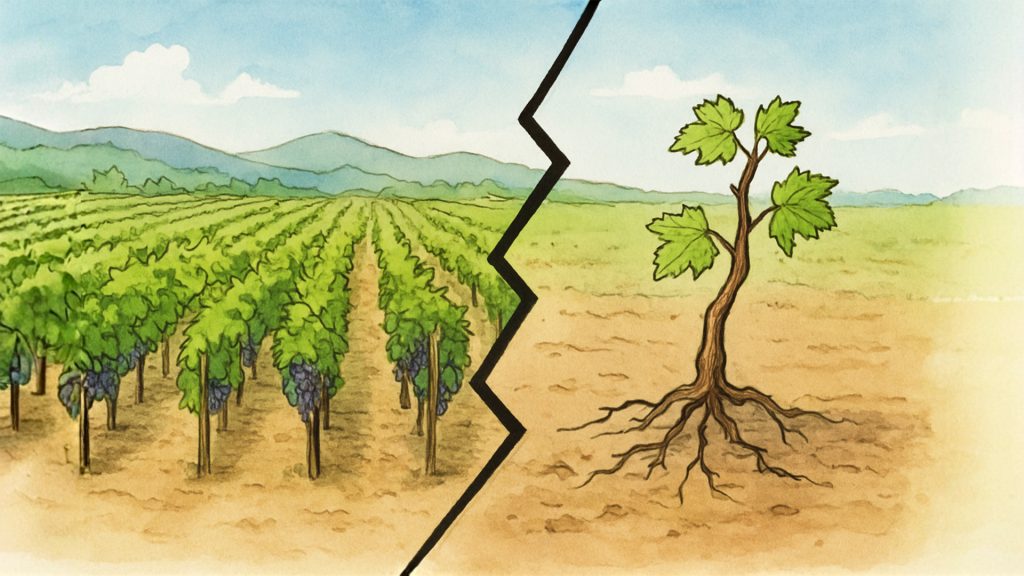
The global vineyard surface stood at 7.0 million hectares in 2025, down 0.8% from the previous year. This marks the sixth consecutive decline. Major producing countries in both hemispheres have continued removing or abandoning less competitive plantings. In the European Union, which accounts for roughly 45% of the world total, France and Spain led reductions. In the Southern Hemisphere, Chile has cut its vineyard by 27% since 2019, while Argentina and others trim steadily. Even in the United States, California’s ongoing uprooting contributed to a seventh year of national decline.
This is no longer purely reactive. While climate events accelerate decisions, the primary driver is alignment with softer demand. Low-yield vintages have masked deeper structural issues, but the gradual thinning of global capacity signals acceptance that excess volume no longer finds reliable buyers.
Global wine output reached an estimated 227 million hectoliters in 2025, a marginal 0.6% increase from the historically low 2024 level and still 13% below the ten-year average. Climate variability hit both hemispheres again. Some regions reduced production deliberately to match market realities. A few Southern Hemisphere countries rebounded from poor 2024 vintages, yet the overall picture remains one of constrained supply.
That constraint has provided breathing room. With industrial uses consuming roughly 30 million hectoliters annually, the production-consumption gap narrowed enough to keep stock pressures broadly contained. Low harvests have bought time, yet they also highlight vulnerability. Future vintages will face more frequent extreme weather. Adaptation through resistant varieties, site selection, and technology will separate resilient producers from the rest.
Consumption decline shows structural roots.
World wine consumption fell to 208 million hectoliters, down 2.7% year-on-year. Nine of the top ten markets recorded lower volumes. Mature markets face generational change, shifting occasions, and competition from other beverages. Economic pressure on purchasing power has compounded these trends. Growth pockets in Brazil, Portugal, Japan, and parts of Eastern Europe offer limited offset.
Subscribe to our newsletter
Wine is no longer structurally central to everyday consumption in most mature markets. This is not a cyclical dip. It reflects long-term evolution in how and why people drink.
Exports dropped to 94.8 million hectoliters (-4.7%) with value falling to 33.8 billion euros (-6.7%). The share of wine consumed outside its country of origin remains high at 46%, underscoring the sector’s global character. Bottled wine bore the brunt of the decline, while bulk and sparkling showed relative resilience in some categories. Average export prices adjusted modestly downward in euro terms but stayed elevated historically. Notably, US wine imports declined 12% to 5.5 billion euros.
Tariffs did not create the fragility; they merely exposed and accelerated a trade environment that was already shifting from volume globalization toward more selective, regional, and value-driven flows. Trade remains a vital outlet, with nearly one in two bottles crossing borders, but the environment has become more fragmented and unpredictable. Bilateral deals may open pockets of opportunity, yet overall uncertainty favors regionalization and caution.
The same structural reckoning that first hit Australia and Chile, where both volume and value declined while industry structures changed permanently, is now unfolding across the globe. Countries with strong domestic markets, successful value repositioning, or favorable climate adaptation trajectories, such as parts of Europe and Brazil, hold clearer paths. Others, still tethered to volume strategies or exposed to export volatility, including Argentina and segments of the United States, face prolonged pressure. Those who have embraced permanent downsizing and value repositioning gain breathing room, while those still anchored to old volume expectations face extended pressure.
The adjustment continues.
The OIV report shows a sector demonstrating resilience. Market balance has held despite softer demand. Trade value, though down, far exceeds pre-pandemic levels. Yet these outcomes stem largely from supply restraint rather than demand revival. Low production has masked erosion on the consumption side and buffered trade shocks. It has not resolved them.
The wine world is settling into a new equilibrium: smaller in planted area and output, more differentiated by quality and story, more dependent on precise consumer targeting, and less forgiving of inefficiency. Passive growth is over. What remains is a smaller, harder, more differentiated wine world, and the question of which players will complete the transition before the next shock arrives.