Prosecco DOC bottled 667 million bottles last year, up 1.1% from 2024, at an estimated value of €3.6 billion. More than 80% of that output left Italy. The United States remained the largest export market, at more than 23% of exports. The United Kingdom followed at nearly 21%. France recorded growth of about 21% and moved into third place.
The category still added bottles in a weak year for wine. It did not add them at the pace of the previous decade. Growth had been 7% in 2024.
How the growth was built
Wine is no longer growing by default. In the main markets, volume has contracted, daily drinking has thinned, and buyers have less patience for a glass that requires an education first. What still moves is narrower: a clear flavour, immediate pleasure, a price that matches the experience, and a style that fits more than one occasion.
Prosecco sits in that opening. The fruit is readable. The bubbles carry the ritual. A drinker does not need a map of appellations to enjoy it, and much of the volume is still priced for a repeat purchase.
Giancarlo Guidolin, president of the Consorzio Tutela Prosecco DOC, refuses a single cause. “There is no single factor behind Prosecco DOC’s performance,” he says. “Rather, it is the result of a combination of strengths that have enabled the denomination to remain resilient in a challenging global wine market.”
The first strength is geographic. The United States, the United Kingdom and Germany remain the core export markets. France and several Eastern European markets supplied the 2025 increment. Greece and Mexico also rose at a double-digit pace. Some markets contracted under geopolitical and economic pressure. The result is less a single growth engine than a portfolio of markets moving at different speeds.
The second strength is occasion. Prosecco did not grow by remaining a wine for toasts. Consumers, Guidolin says, “increasingly appreciate wines that are approachable, enjoyable and suited to a variety of occasions.” The wine moved into the aperitif, the meal and the cocktail list. Villa Sandi vice president Diva Moretti Polegato makes the same point from the producer side: demand has held because the wine is still tied to “social occasions and aperitivo culture,” and because it can move between those moments without much explanation.
Prosecco is present in more informal drinking occasions than it was a decade ago. It is not, on the evidence of 2025, the default sparkling wine of everyday life. It is a wine that found more hours in the week.
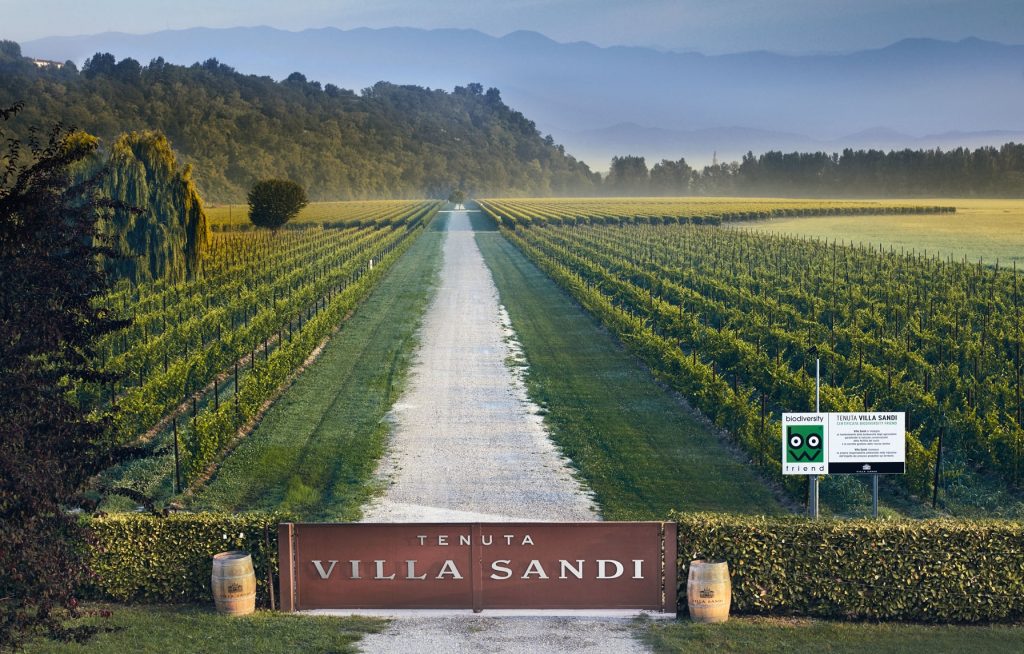
The third strength is restraint on the supply side. Since 2017, Guidolin notes, any increase in vineyard area eligible for the denomination has been tied to sustainability certification and biodiversity commitments, including land set aside for hedgerows and woodland. The Consorzio’s language for 2026 is consistent with that brake. The aim is not simply more bottles. It is value that the production chain can keep, on land the denomination can still defend.
Cantina Pizzolato co-owner Sabrina Pizzolato saw the same year from inside one company. “2025 will be for sure remembered as one of the most challenging of our history,” she says. The United States and Germany were under economic and geopolitical strain. The offsets, for her company, were France, Scandinavia, Southeast Asia and the Caucasus. Old markets still matter, and they no longer all move together.
One name, several expressions
Different occasions now sit under the same name.
“The Prosecco world offers consumers a range of expressions that reflect different territories, production conditions and styles, rather than a simple hierarchy of quality,” Guidolin says. “Each denomination has its own identity and distinctive characteristics. Production costs, vineyard management and yield regulations naturally influence price positioning, while quality remains a defining factor within every denomination.”
Different rules, different costs and different styles let the same category name cover frequent, informal drinking and, where producers choose to place it, a more expensive glass. The category does not have to pick one consumer.
“We see our Prosecco portfolio as a balanced range designed to address different consumer needs and occasions, rather than simply different price points,” Moretti Polegato says. “At the core is our Prosecco DOC, which represents the heart of the portfolio and plays an important role in bringing our style and quality to a broad consumer base. It is accessible, versatile and particularly well suited to aperitivo and everyday social occasions.” Their DOCG wines, she adds, “sit at the more premium end of the range. They allow us to offer greater differentiation and to trade consumers up, while highlighting the quality and character of the Prosecco Superiore appellation.”
At Pizzolato, DOC is the core in volume and brand recognition, and it fits off-trade on value. A DOCG line finds more space in on-trade. A no-added-sulphites Prosecco is kept as a low-intervention expression.
Rosé is now large enough to treat as structure, not as a novelty. Prosecco DOC Rosé accounted for 60.4 million of the 667 million bottles in 2025, about 9% of the denomination. Guidolin calls it one of the most successful innovations of recent years: it put the denomination into sparkling rosé, brought in new occasions, and, because the production rules are stricter, created “opportunities for premiumisation” in markets and channels that reward differentiation and added value.
Moretti Polegato sees the same wine as more than a colour swap. It has helped Villa Sandi attract new consumers and new occasions, especially where “visual appeal and a sense of celebration are important.” Pizzolato is blunt about cannibalisation. She would not say rosé is stealing Prosecco sales. “Perhaps the opposite.” Sparkling rosé, she says, has opened attention that then made room for more bubbles, including Prosecco.
Subscribe to our newsletter
Alcohol is being tested in two different legal places. Inside the denomination, the Consorzio is looking at lighter styles. “Following the successful introduction of Prosecco DOC Rosé, further innovation opportunities are being explored, including products that respond to growing demand for lighter and lower-alcohol wine styles,” Guidolin says. Pizzolato puts a number on the industry discussion: a possible low-alcohol path at 8% ABV, referred to as UNICA PROSECCO. That path is still exploratory.
Outside the name, the rule is already clear. “The current Prosecco DOC/DOCG regulations do not allow wines under these denominations to be partially or fully dealcoholised,” Pizzolato says. The work therefore happens under sparkling and drink labels. Villa Sandi, through La Gioiosa, has a Zero Alcohol sparkling drink and a Rosé Zero Alcohol version. “We see them as an opportunity to expand the category and introduce the La Gioiosa experience to a broader audience, not as a substitute for wine, but as an additional choice for different occasions and consumer needs.” Pizzolato is building white and rosé dealcoholised sparkling wines, plus wine-based zero cocktails such as Spritz Zero, Hugo Zero and Bellini Zero, and wants to be Italy’s leading producer of organic dealcoholised sparkling wines by the end of 2026.
Those products sit beside Prosecco. They do not complete it. As the producers describe them, they add an occasion, and with it a chance to raise frequency, rather than replace a bottle of Prosecco.
Taken together, this is a Brand Gradient Flow. Prosecco holds different standards, styles, alcohol levels, price positions and drinking occasions, so a drinker can enter on one occasion and remain within the category when the occasion changes.
Three markets, three executions
Commercial strategy, Guidolin says, belongs to producers. The Consorzio protects the name, educates the trade and runs promotion. Markets still do not behave as one.
The United States is the largest market and the hardest to read from shipment data alone. Moretti Polegato, citing Consorzio figures, puts U.S. export volumes up 3.4% in 2025, with distributor data up 3.7%. Simone Bonomini, export manager at Momento Fine Wines, adds the caution those figures do not: some of the shipments were inventory built ahead of possible tariffs. Shipment growth is not the same thing as consumption growth.
The execution problem in the United States is not only cost. Moretti Polegato describes a market in which consumers have become “more selective about how and when they spend,” while Prosecco still fits aperitivo, brunch, dining and informal drinking at home. Pizzolato’s house view is more aggressive. After a year of tariff uncertainty, she expects a rebound approaching 50% for her company in 2026, driven by organic Prosecco and no-alcohol products. That is a producer forecast, not a category forecast. It does show where at least one exporter thinks American demand is still reachable: on brand loyalty, and on products that sit next to Prosecco, even after tariff-driven retail prices.
The United Kingdom is the other volume pillar, and the quietest of the three. Exports grew 1.1%. Villa Sandi still treats it as one of two core export markets. The work there is rotation, presence and the spritz occasion, not a new growth story.
France is the market that changed position. Growth of about 21% put it third, ahead of Germany. Guidolin reads that as proof that Prosecco can find consumers in a country with its own sparkling wines. Bonomini, who watches on-trade closely, points to restaurants and bars as a channel where the wine has become easier to place. France shows that occasion and price can open a market that already has Champagne and Crémant. It does not show that French drinkers have changed allegiance.
Pizzolato’s newer maps (Scandinavia, Southeast Asia, Armenia, Georgia) are evidence that the export model still finds openings. They are not large enough, on 2025 evidence, to replace the United States or the United Kingdom.
What kind of growth is still available
Guidolin’s brief for 2026 is to “consolidate the value of Prosecco DOC and to guarantee a fair profitability for the entire supply chain,” while watching climate as closely as markets. “The objective is not simply to increase volumes, but to consolidate the denomination’s achievements by creating long-term value.”
Moretti Polegato expects “a combination of volume and value, but with a stronger focus on improving the overall value of the business.” There is still room, she says, to reach new consumers and occasions. Brand position and more differentiated wines will matter more than they did when the category was still filling space.
Pizzolato puts it more sharply. “No doubt the growth, or even the consolidation of each trend, category or single brand has to be driven by the value.” In a market where supply of ordinary wine exceeds demand, she argues, the producers who stay are the ones who can change both the wine and the language around it.
Bonomini’s market view is the check on any clean turn toward value. Pressure in a tight, promotional trade can still pull the average category toward volume, even while more differentiated producers go the other way. That is not a forecast of winners. It is a reminder that retail scale does not step aside because producers would prefer it to.
The pace of the last expansion is unlikely to return. The base is now 667 million bottles. New vineyard area is conditional. The two largest export markets are either hard to read or nearly flat. France, rosé and a few newer markets still added bottles in a year when much of still wine did not.
What remains is more distributed than the boom years were. Some of it will come from markets that are still adding, some from denser use of occasions the category already occupies, some from product variation (rosé, organic and no-sulphite wines, lower-alcohol trials, and zero-alcohol sparkling beside the denomination), and some from value rather than from another wave of bottles.
Prosecco after the boom is not waiting for the next engine. It has to keep finding growth without the conditions that built the last decade.