For more than a decade, premiumisation served as the global spirits industry’s closest thing to a universal growth formula: trade consumers up, expand margins, and repeat. That comfortable assumption is now under strain.
From boardrooms in London to distributor meetings in New York and Shanghai, a subtle but unmistakable shift in mood has taken hold. Ten years of steady upward trading have given way to a more uneven reality. Different categories, price tiers, and markets are no longer moving in the same direction. Premiumisation has not disappeared. It has lost its monopoly. What was once a broad rising tide is becoming far more selective.
Category Divergence
The split is most visible at the ultra-premium end. Cognac, long seen as one of the most reliable premium growth engines, is facing real pressure. LVMH Wines & Spirits (full-year 2025) declined 5% organically, with Hennessy weighed by softer local demand in China Mainland and tariff headwinds in the United States. Pernod Ricard’s Martell (H1 FY2025–26) recorded heavy declines in China Mainland, though South Africa and Nigeria offered some offsets. Rémy Cointreau’s Cognac division (9M FY2025–26) posted a 4.3% organic decline, even though the third quarter rebounded 3.2% on solid Americas performance.
In contrast, accessible premium and occasion-driven categories are proving more resilient. Campari’s Espolòn (FY 2025) grew 3% organically, with its Reposado variant up 8% and RTD extensions accelerating in markets like Australia. Diageo’s spirits ready-to-drink portfolio (H1 FY2026) rose 17% organically, led by Smirnoff. Brown-Forman’s New Mix innovation delivered 34% organic growth in emerging markets such as Mexico.
Whisky sits in the middle. Some accessible and flavour-led expressions continue to perform well, such as certain Johnnie Walker variants and Crown Royal innovations. Yet overall momentum in mature markets remains mixed and sensitive to the same affordability challenges affecting Cognac.
This divergence appears increasingly structural rather than purely cyclical. The categories that are slowing and the categories that are accelerating are being driven by different consumer motivations. Premiumisation itself is splitting into distinct paths: one for traditional status-driven ultra-premium expressions that are losing steam, and another for accessible, convenient, and occasion-led formats that are still recruiting new consumers.
Geography Fragmentation
The same selectivity is playing out across regions. Mature markets are entering a consolidation phase after years of aggressive premium trade-up. In the United States, several producers reported softness driven by stretched consumer wallets and competition from more affordable alternatives. Pernod Ricard saw organic sales fall 15% in the US during the first half of FY2025–26, reflecting weakness in key mature markets. Brown-Forman posted a modest 1% organic decline overall, with US net sales down 8% reported.
China Mainland has presented even greater challenges. Diageo’s Chinese baijiu business weighed heavily on the group, Pernod Ricard reported a 28% organic decline there, and LVMH’s Hennessy faced additional pressure from duties and softer sentiment.
Emerging markets, however, continue to offer meaningful growth. India sustained premium momentum, with Pernod Ricard delivering 4% organic growth (8% excluding a divested local brand) powered by trade-up in Jameson, Ballantine’s and Absolut. Africa and Latin America and the Caribbean also showed strength. Diageo highlighted robust growth in these regions that helped offset North American weakness, while Campari benefited from solid contributions through aperitifs and agave.
The geographic map of spirits growth is being redrawn. Traditional developed markets face inventory digestion and demand normalisation, while select emerging regions remain important pockets of premiumisation.
The Inventory Hangover
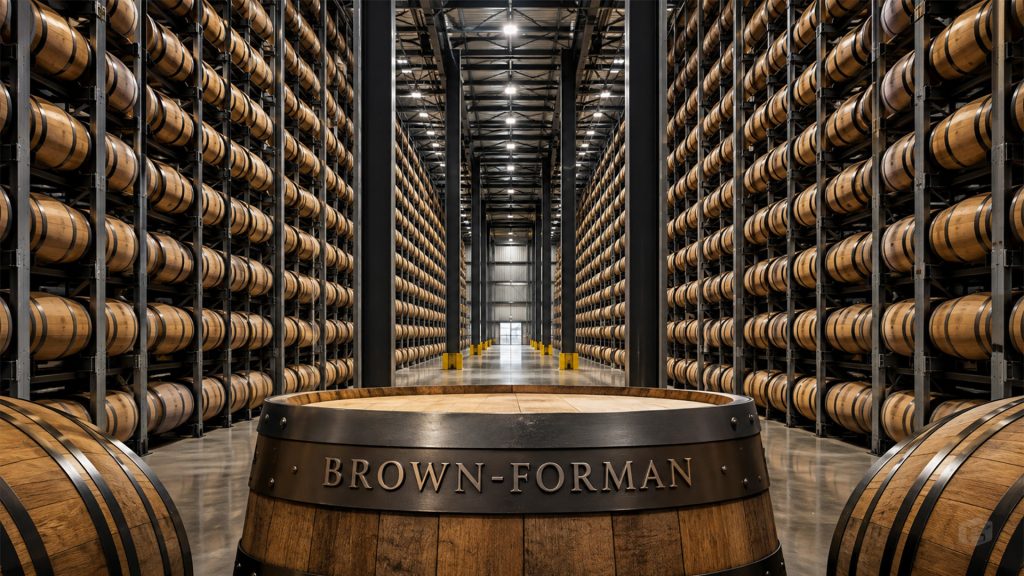
Underlying many of these divergences is a shared structural issue: supply built for a world that no longer exists. The pandemic consumption boom led to capacity expansions and significant aged inventory build-up, especially in Cognac and Scotch. When demand normalised, distributors began destocking.
Pernod Ricard cited inventory adjustments in both the United States and China Mainland. Brown-Forman noted net distributor inventory increases in the US and emerging markets, yet depletions often lagged shipments. The result has been persistent pressure on price and mix, particularly in aged categories where supply cannot be adjusted quickly.
Strategic Reset
Faced with this new reality, leading groups are moving in broadly similar directions. They are streamlining portfolios through targeted divestments and rationalisation, accelerating cost and supply-chain efficiency programmes, and shifting marketing investment from broad growth spending toward more focused defence of core brands. Financial flexibility and balance-sheet discipline have also become higher priorities.
The emerging playbook is becoming clearer. Premiumisation no longer guarantees growth. What matters now is execution, meaning the ability to convert shipments into real consumer takeaway at the right price and in the right place. Companies must decide which price tier to defend, which category to prioritise, which geography to focus on, and which consumption occasion to own.
Premiumisation once served as the industry’s universal growth engine. That engine still runs, but it no longer powers every market or category. In the fragmented landscape now emerging, execution, not assumption, will separate the winners from the rest.